Royalty F - J

Frederick I., King (1657-1713)
Rare autograph letter signed by the first King of Prussia
Was (as Frederick III.) Elector of Brandenburg (1688–1713) and Duke of Prussia in personal union (Brandenburg-Prussia). The latter function he upgraded to royalty, becoming the first King in Prussia (1701–1713). Rare autograph letter signed “Friedrich R.”. 1 page, bifolium, 10.0 x 8 inch (unfolded), no place, 1704 August 26. Addressed to “Chambellandt de Cameke”. In German, in full: Lieber Kameke (?), Es ist mir hertzlich leidt dass Unglück so Du gehabt hast, Ich wünsche dass dieses Schreiben Euch wieder völlig (?) besser finde, und ihret Dich dankbar hat (?) wieder bei mir zu kommen, der Ich im dessen lebenslang bin, derselbe ehrwürdige … König.“ Red wax seal intact. Mounted on cardboard, slightly discolored, verso with an old typed note regarding the letter, dated June 1949. Else good condition. Rare in autograph letter signed.
Price: $ 1,200 / € 1.000

Frederick II. - The Great (1712-1786)
Letter signed regarding the Jesuit Order
King of Prussia from 1740 until his death. His political prowess and enlightened attitudes toward religion, learning, and the humanities earned him the sobriquet “Frederick the Great”. Letter signed „Federic“. 1p., bifolium, 7.25 x 9.0 inch, Potsdam, 1775 May 11. To Abbé Matteo Ciofani (1715–1798) in Rome from 1763 onwards, the “confidant” of the Prussian Crown among the Vatican clergy (Prussian Resident), whom he had commissioned to intercede with Pope Pius VI. for the preservation of the Jesuit Order, which had been suppressed in 1773. In French: „... En effet, voila deja deux mois passés, que le nouveau Pape a pris le gouvernail de l’eglise, sans que Je sache, si vous avés entamé vôtre negociation, et quelle apparence il y a pour son succès. Elle n’est pourtant rien moins que difficile; et à vous dire vrai, il y a deja longtems, que Je me suis attendû, d’apprendre au moins les premiers pas, que vous avés faits, pour la conduire à une bonne fin ...”. Translated: „... Indeed, two months have already passed since the new Pope took the helm of the Church, yet I remain unaware of whether you have commenced your negotiations, or what prospects there are for their success. The task is, however, by no means easy; and to tell you the truth, I have long been expecting to learn - at the very least - of the initial steps you have taken to bring it to a successful conclusion ...”. Mailing folds, else fine condition. The Jesuit Order (officially the Society of Jesus) is one of the largest Catholic male religious orders, founded in 1540 by Ignatius of Loyola. The suppression of the Jesuit Order in 1773 was a historical event in which Pope Clement XIV., under pressure from the Bourbon monarchies (France, Spain, and Portugal), banned the Society of Jesus worldwide. The Order was accused of being too powerful and politically active. The suppression remained in effect until its restoration in 1814. In 1773, Frederick the Great refused to implement Pope Clement XIV's ban on the Jesuit Order in Prussia. As an enlightened ruler, he valued the Jesuits as capable teachers for his educational system. He permitted them to remain as teachers and spiritual guides, thereby preserving the Order in Silesia and other parts of Prussia.
Price: $ 1,440 / € 1.200
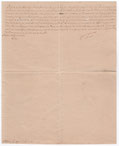
Frederick II. - The Great (1712-1786)
Letter signed regarding the Jesuit Order
King of Prussia from 1740 until his death. His political prowess and enlightened attitudes toward religion, learning, and the humanities earned him the sobriquet “Frederick the Great”. Letter signed „Federic“. 1p., bifolium, 7.25 x 9.0 inch, Berlin, 1775 May 22. To Abbé Matteo Ciofani (1715–1798) in Rome from 1763 onwards, the “confidant” of the Prussian Crown among the Vatican clergy (Prussian Resident), whom he had commissioned to intercede with Pope Pius VI. for the preservation of the Jesuit Order, which had been suppressed in 1773. In French: “... Le Pape n’ait pas bien saisi Mon idée. Il ne s’agit nullement de lui demander quelque chose, qui pût choquer Sa Sainteté, ou blesser sa dignité. Mon unique but, dans la conservation de l’ordre des Jesuites est, de Leur continuer la direction de l’instruction de la jeunesse, dont ils s’acquittent si bien ...”. Translated: “... The Pope may not have fully grasped my idea. There is absolutely no question of asking him for anything that might offend his Holiness or wound his dignity. My sole objective in preserving the Jesuit Order is to allow them to continue directing the education of the youth - a task they perform so admirably ...”. Mailing folds, else fine condition. The Jesuit Order (officially the Society of Jesus) is one of the largest Catholic male religious orders, founded in 1540 by Ignatius of Loyola. The suppression of the Jesuit Order in 1773 was a historical event in which Pope Clement XIV., under pressure from the Bourbon monarchies (France, Spain, and Portugal), banned the Society of Jesus worldwide. The Order was accused of being too powerful and politically active. The suppression remained in effect until its restoration in 1814. In 1773, Frederick the Great refused to implement Pope Clement XIV's ban on the Jesuit Order in Prussia. As an enlightened ruler, he valued the Jesuits as capable teachers for his educational system. He permitted them to remain as teachers and spiritual guides, thereby preserving the Order in Silesia and other parts of Prussia.
Price: $ 1,440 / € 1.200

Frederick II. - The Great (1712-1786)
Letter signed
King of Prussia from 1740 until his death. His political prowess and enlightened attitudes toward religion, learning, and the humanities earned him the sobriquet “Frederick the Great”. Letter signed „Federic“. 1p., bifolium, 7.5 x 9.25 inch, Potsdam, 1780 June 14. To Abbé Matteo Ciofani (1715–1798) in Rome from 1763 onwards, the “confidant” of the Prussian Crown among the Vatican clergy (Prussian Resident). In French: „J'ai recu votre lettre du 17 da Mai dernier, avec toutes ses incluser, et Je vous adresse, a la suite de la presente, Mes reponses aux freres Ducs de St. Arpino, pour l coleur remettre, avec un compliment conversable...“. Translated: “I received your letter of May 17th, along with all its enclosures, herewith, I am sending you my replies to the brothers, the Dukes of St. Arpino, for you to deliver to them, accompanied by a suitable compliment…“. Mailing folds, else fine condition.
Price: $ 1,200 / € 1.000
Frederick II. - The Great (1712-1786)
Letter signed
King of Prussia from 1740 until his death. His political prowess and enlightened attitudes toward religion, learning, and the humanities earned him the sobriquet “Frederick the Great”. Letter signed „Federic“. 1p., bifolium, 7.5 x 9.0 inch, Potsdam, 1781 May 10. To Abbé Matteo Ciofani (1715–1798) in Rome from 1763 onwards, the “confidant” of the Prussian Crown among the Vatican clergy (Prussian Resident). In French: „Votre depeche du 7 d'Avril M'apprec., a la verite, les difficultes, que vous rencontres, dans l'affaire dei. L'Abbe du ... Main Je vous les ne Me parois de nature, a fermer a cet ecclesiasti que, tout acces a L'Episcopat. Qu il uit ete Moine ou ... cie ou Docteur de Sorbonne; ce sont, dans le fondes des riens, ainsi que vous les taxes vous meme; eta e M'attens, que vous continueres, a employertout votre savoir“. Translated: “Your dispatch of April 7th has, admittedly, apprised me of the difficulties you are encountering in the matter of the Abbé du... Yet these difficulties do not appear to me to be of a nature to bar this ecclesiastic from all access to the Episcopate. Whether he was a monk, a cleric, or a Doctor of the Sorbonne - these are, fundamentally, trifles, just as you yourself have deemed them to be; and I fully expect that you will continue to employ all your expertise in this regard“. Mailing folds, writing a little light, else good condition.
Price: $ 1,200 / € 1.000
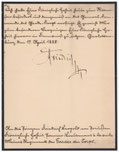
Frederick III. (1831-1888)
Exceedingly rare letter signed as King & Emperor (1888/ 99 days)
Frederick III. was German Emperor and King of Prussia for 99 days in 1888, the Year of the Three Emperors. Friedrich Wilhelm Nikolaus Karl, known informally as Fritz, was the only son of Emperor William I. and was raised in his family's tradition of military service. Although celebrated as a young man for his leadership and successes during the Second Schleswig, Austro-Prussian and Franco-Prussian wars. Rare letter signed “Friedrich”, as King and Emperor. 1p., bifolium, 8.25 x 10.5 inch, Charlottenburg, 1888 April 17. Black border mourning stationery (his father Wilhelm I. died on March 9, 1888). To his nephew Prince Friedrich Leopold, "Premier-Lieutenant à la suite Meines Regiments der Gardes du Corps", regarding his appointment as cavalry captain. In German, in full: “Ich habe seine königliche Hoheit heute zum Rittmeister befördert und demgemäß an das General-Kommando des Garde-Korps verfügt. Es gereicht mir zum besonderen Vergnügen seine königliche Hoheit hiervon in Kenntniß zu setzen“. A large and bold signature, dated during his short reign. Mounting residue on the blank second page of the bifolium, handling wear, else good condition. Exceedingly rare. After 27 years as Crown Prince, Frederick III. became Emperor, but suffering from cancer of the larynx he died aged 56 after reigning for only three months.
Price: $ 2,100 / € 1.750

Frederick III. (1831-1888)
Rare autograph note signed as King & Emperor (1888/ 99 days)
Frederick III. was German Emperor and King of Prussia for 99 days in 1888, the Year of the Three Emperors. Friedrich Wilhelm Nikolaus Karl, known informally as Fritz, was the only son of Emperor William I. and was raised in his family's tradition of military service. Although celebrated as a young man for his leadership and successes during the Second Schleswig, Austro-Prussian and Franco-Prussian wars. Rare autograph note signed “Friedrich”, as King and Emperor. 1p., 3.75 x 6.0 inch, n.p., n.d. One of the conversation slips of the terminally ill emperor, written during the 99 days. In German, in full: “Ich bitte um Abschrift der Zeiteinteilung für die Herbstübungen des GardeCorps”. Translated: “I would like to request a copy of the time schedule for the GardeCorps' fall exercises”. Horizontal and vertical fold, minor handling wear, ink name note at the bottom, else fine condition. Exceedingly rare. After 27 years as Crown Prince, Frederick III. became Emperor, but suffering from cancer of the larynx he died aged 56 after reigning for only three months.
Price: $ 1,200 / € 1.000

Frederick III. (1831-1888)
Autograph note as Emperor during the 99 days
Frederick III. was German Emperor and King of Prussia for 99 days in 1888, the Year of the Three Emperors. Friedrich Wilhelm Nikolaus Karl, known informally as Fritz, was the only son of Emperor William I. and was raised in his family's tradition of military service. Although celebrated as a young man for his leadership and successes during the Second Schleswig, Austro-Prussian and Franco-Prussian wars. One of the conversation slips of the terminally ill emperor, written during the 99 days. Autograph note unsigned „1 ½ Stunden nach Tisch fest eingeschlafen“. 1p., 4.5 x 4.0 inch, June 1888, written in pencil. Mounted on a thin sheet with information about the Emperor and the autograph. Uneven lower edge, small repaired tear, else good condition. Frederick III. autographs during the 99 days are exceedingly rare.
Price: $ 480 / € 400

George VI., King (1895-1952) & Chamberlain, Neville (1869-1940)
Document signed by both
George VI. was King of the United Kingdom and the Dominions of the British Commonwealth from 11 December 1936 until his death. Neville Chamberlain was a British Conservative politician who served as Prime Minister of the United Kingdom from May 1937 to May 1940. Document signed "app'd GRI” and "N. Chamberlain". 1 page, bifolium, 7.5 x 9.5 inch, 10 Downing Street letterhead, 1937 November 15. Letter of recommendation to King George VI. In part: "Mr. Chamberlain, with his humble duty to the King, respectfully recommends to Your Majesty the appointment of the Reverend John Willie Davis, Vicar of St. Faith, Lincoln, to the Vicarage of St. Mary Magdalene, Gedney, vacant by the death of the Reverend Theodore Crombie Gobat, M.A." Signed at the head by King George VI. With a small filing hole to the upper left corner, else fine. Rare combination of signatures.
Price: $ 1,440 / € 1.200
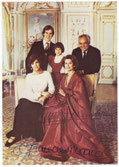
Grace (1929-1982) and Rainier (1923-2005) of Monaco
Signed photograph
Grace Kelly was an American film actress and Princess of Monaco as the wife of Prince Rainier III. Prior to her marriage, she achieved stardom in several significant Hollywood films in the early to mid-1950s. Rainier III. ruled the Principality of Monaco for almost 56 years, making him one of the longest ruling monarchs of the 20th century. Best known outside of Europe for having married American actress Grace Kelly in 1956. A fine signed color postcard photograph signed "Grace de Monaco” and “Rainier Prince de Monaco”. 4.25 x 6.0 inch, n.p., n.d. Fine condition! Great signed photograph, especially with both signatures.
Price: $ 600 / € 500

Gustaf VI. Adolf, King (1882-1973)
Signed presentation photograph
King of Sweden from 29 October 1950 until his death. He was the eldest son of King Gustaf V. and his wife, Victoria of Baden, and had been Crown Prince of Sweden for the preceding 43 years in the reign of his father. Vintage signed presentation photograph “Gustaf Adolf 1938”. 6.5 x 8.5 inch visible, 9.25 x 11.5 overall. Showing Gustaf VI. Adolf in a formal half length pose wearing his uniform. Signed in fountain pen ink to the lower photographer's mount and dated 1938 in his hand. Additionally signed by the photographer in white fountain pen ink to the lower right corner of the image. Framed and glazed in the original red/ brown leather presentation frame by P.A. Norstedt in Stockholm and bearing a gilt stamped crown at the head. Handling wear to the frame, else good condition and excellent signed.
Price: $ 840 / € 700

Hirohito, Emperor (1901-1989) & Kojun, Empress (1903-2000)
Scarce oversized formal presentation photographs signed
Emperor of Japan from 1926 to his death in 1989. Following the devastating result of the atomic bombs dropped on Nagasaki and Hiroshima in World War II, he renounced his divinity in favor of a democratic constitutional monarchy. Empress Kōjun, born Princess Nagako was a member of the Imperial House of Japan and the wife of Emperor Hirohito. Incredibly scarce set of vintage matte-finish three-quarter length photographs of Hirohito and Empress Nagako. 8.5 x 12.75 inch, n.p., n.d. (about 1957), beautifully signed in thick black ink in Japanese by the emperor and empress. Inserted with photo corners in the original presentation folders, bearing an embossed gold Imperial Seal of Japan (called the Chrysanthemum Seal) on the front. Photographs in very fine condition, folders with minor handling and corner wear. Few Hirohito/ Kojun signed photographs are made available to the collecting public, particularly those of this quality and size. A wonderful pair and one of the finest you can hope to find.
Price: $ 9,600 / € 8.000